


3 min read
Lorenz Leuchten GmbH × Mahdi Naim Studio: Dialogue Between German Precision and Discipline of Thought
READ POST
SHARE:
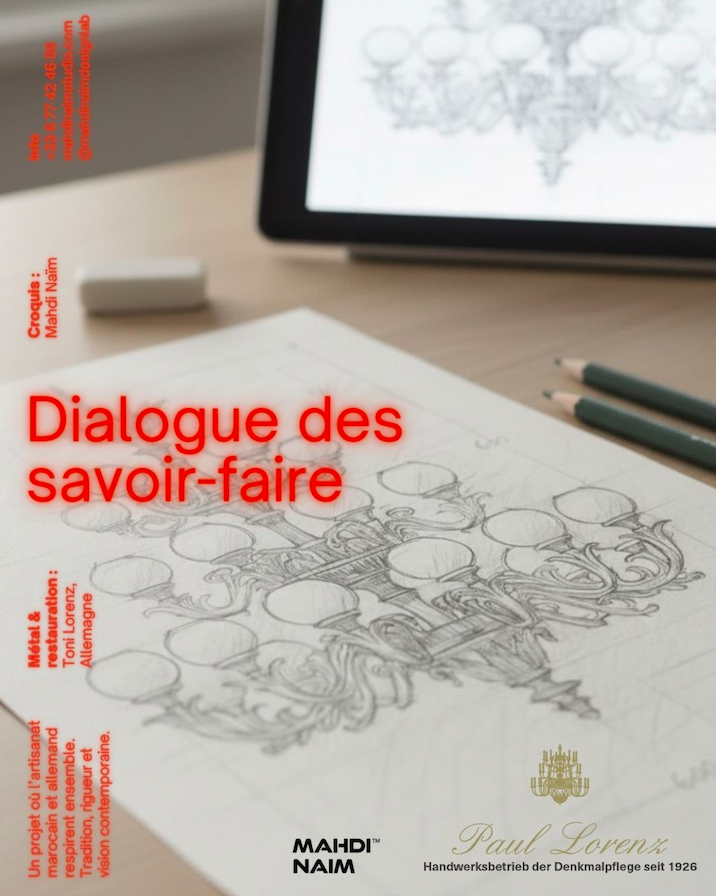
2025 Collaboration — Baroque Craft
In 2025, I am developing a project with Lorenz Leuchten GmbH, a German manufacturer of luminaires for heritage restoration. This collaboration takes root in a decisive encounter: Denkmal Leipzig 2024, the largest European heritage restoration trade fair, where Morocco was the guest of honor.
I am a Moroccan designer. I have been working on Moroccan craft for fifteen years. But this collaboration does not concern Moroccan craft. It falls within the framework of European baroque craft. This shift is neither anecdotal nor opportunistic. It engages a fundamental question: can a designer work in a tradition that is not his own, without betraying that tradition, without folklorizing it, without projecting onto it what he knows elsewhere?
The answer depends on one thing: discipline.
Denkmal Leipzig 2024: The Context of the Encounter
Denkmal Leipzig is the largest European trade fair dedicated to heritage preservation and restoration. It brings together architects in charge of classified buildings, curators, specialized craftspeople, and manufacturers of heritage materials. Morocco was invited as guest of honor — not to showcase tourism, but to demonstrate a patrimonial discipline: structured, documented, transmitted, capable of engaging in dialogue with the great European conservation traditions.
It was in this context that I discovered the Lorenz Leuchten GmbH workshop. A Germany-based manufacturer specializing in luminaires for heritage spaces: baroque churches, castles, classified historic buildings, museums. Their clientele: architects in charge of restorations, cultural institutions, private foundations. No mass-market distribution. No retail sales. Only identified, discussed, validated projects.
The workshop visit was decisive. Not for what was being produced — baroque, rococo, neoclassical luminaires — but for the way it was being produced. What I discovered there was a discipline of thought embodied in gesture.
Lorenz Leuchten: Portrait of a German House
Lorenz Leuchten GmbH is neither a manufacturer in the industrial sense nor a decorative arts gallery. It is something more precise: a company organized around a craft discipline, capable of producing restoration luminaires faithful to baroque, rococo or neoclassical models, while integrating current technical constraints (electrical standards, fire safety, conservation norms).
This is not reproduction. It is restitution — technically rigorous, historically documented, materially coherent with the spaces for which these luminaires are destined.
German Craft Tradition: A Structural Principle
German craft tradition is not nostalgic. It does not seek to reproduce the past out of sentimental fidelity. It keeps know-how alive because it is operative — because it produces results that industrial methods cannot achieve.
German Handwerk rests on three structuring principles: regulated transmission through mandatory stages (apprenticeship, journeyman, master examination); rigor as a structuring principle (precision is not perfectionism, it is the refusal of approximation); and form from constraint (the baroque luminaire’s form emerges from the structural and luminous constraints of the space it occupies). Both Moroccan craft and German baroque tradition refuse the arbitrary.
It is this mutual recognition that made the encounter with Lorenz Leuchten possible. Not “we do the same thing,” but “we share the same demand.”
The 2025 Collaboration: Positioning and Principle
The 2025 collaboration between Lorenz Leuchten GmbH and Mahdi Naim Studio does not concern Moroccan craft. It falls within the framework of European baroque craft. I am a Moroccan designer. My main work concerns Moroccan craft, its formal principles, its intellectual reinvention. But this collaboration does not seek to bring Morocco into the baroque. It does not seek to “fuse” aesthetics or produce a “Moroccan baroque” or “hybrid Orient-Occident luminaire.” These categories are inoperative.
What this collaboration does: it applies a discipline of design — developed in contact with Moroccan craft, then confirmed by the German Design Award in a European context — to a formal tradition I did not master before this encounter. My proposal is valid only if it meets the criteria of the baroque tradition and Lorenz Leuchten’s requirements. This acceptance is not submission. It is discipline.
Rigor as Common Language
What enables a real collaboration between two apparently distinct worlds — a German manufacturer of baroque luminaires and a Moroccan designer specialized in Maghrebi craft — is not cultural proximity. It is shared rigor. The demand for precision, technical documentation, coherence between gesture and result: these are universal requirements, independent of cultural origin.
The project will be revealed when it is realized, tested, and validated. What I share here is the anchor point: an encounter, a common demand, and a shared discipline.
2025 collaboration — Lorenz Leuchten GmbH (Germany) × Mahdi Naim Studio (Morocco). Baroque craft heritage restoration.
Related Posts
NEWSLETTER SUBSCRIBE
Stay ahead with our web updates
Avalanche powers a global community of builders creating real use cases for real impact.