


Thinking Design Differently
Innovation is often associated with the idea of absolute novelty.
New product.
New material.
New technology.
New production line.
In many companies, developing still means starting almost from scratch. Designing a new object involves new prototypes, new costs, new industrial adjustments, and sometimes even new manufacturing infrastructure.
This logic has long structured the way product design is thought of.
Yet, today it is reaching its limits.
Not only for economic or environmental reasons. But also because it underestimates an essential resource: the intelligence already present in existing systems.
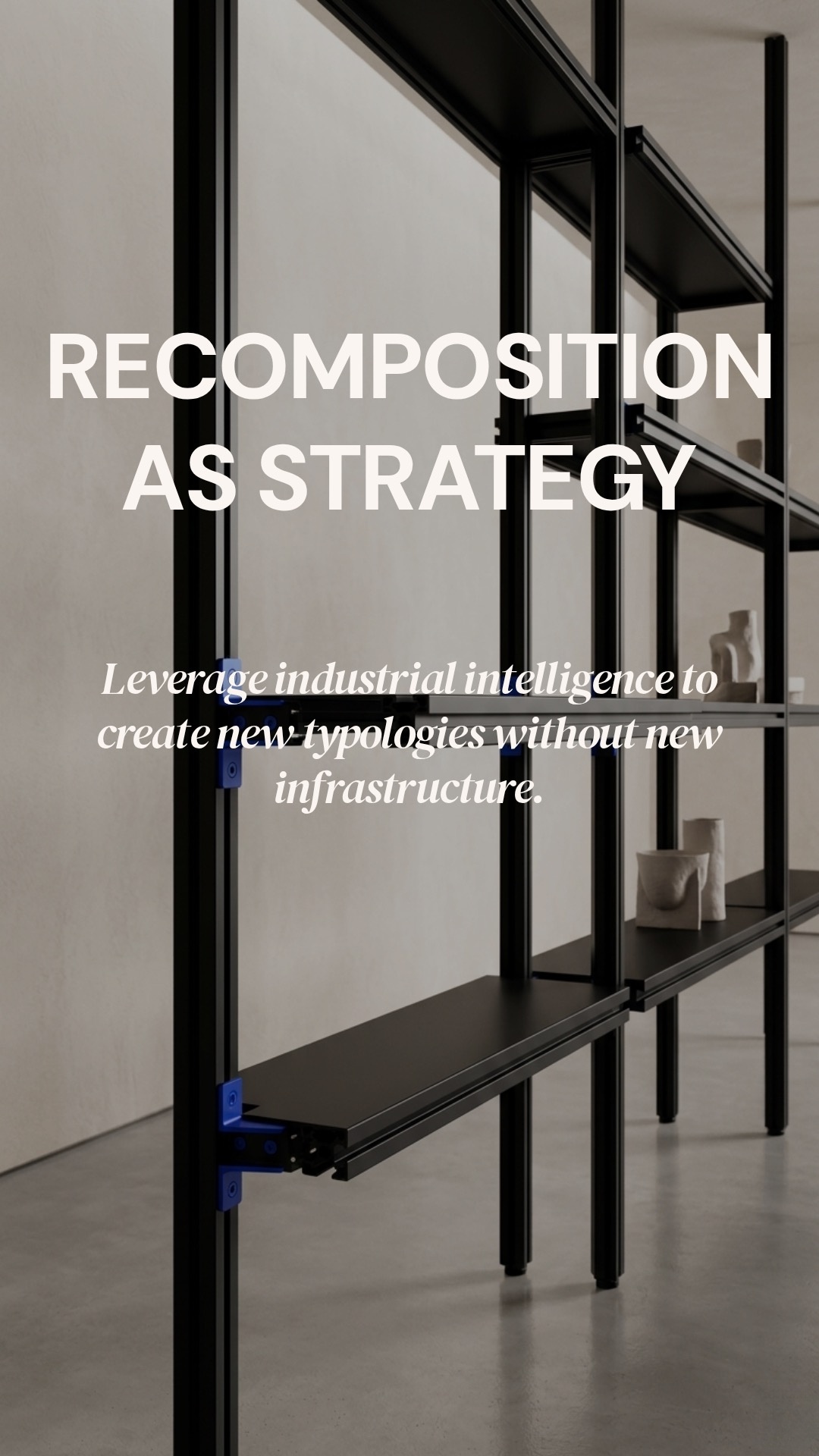
It is from this observation that an approach I developed within Mahdi Naïm Studio was born: System-Based Circular Design.
This methodology is based on a simple idea.
A product catalog should not be considered a fixed collection of finished objects.
It can become a living system.
A set of components, structures, assembly logics, and technical relationships capable of being reread, reinterpreted, and recombined to generate new product typologies.
In other words: rather than always creating more, it becomes possible to create differently.
The role of the designer then changes profoundly.
It is no longer just about drawing a new shape.
It is about observing an existing system, understanding its invisible rules, identifying its untapped potential, and then proposing new configurations capable of producing new uses.
It is a different stance.
More strategic.
More attentive.
More precise.
It requires thinking not about the isolated object, but about the language that makes it possible.
This approach opens up several perspectives.
First, it considerably reduces the industrial weight of development.
When a company already possesses mastered components, stabilized expertise, and a proven production chain, recomposing the existing often becomes much more relevant than producing ex nihilo.
Development costs decrease.
Prototyping becomes lighter.
Time to market is shortened.
But the interest is not only operational.
It is also conceptual.
Design ceases to be a gesture of replacement.
It becomes a gesture of transformation.
We no longer seek to erase what exists to replace it with something else.
We reveal what already exists, in a new form.
This is where circularity takes on its full meaning.
Not as a marketing argument.
Not as a green aesthetic plastered onto a discourse.
But as a rigorous way of considering the existing as a project material in its own right.
In this logic, circularity is not a constraint.
It is a creative lever.
It forces us to look more closely.
To think more finely.
To design with more structural intelligence.
It is also a way to open up new territories of application.
A system designed for a given use can, through recomposition, find a place in other contexts: interior architecture, hospitality, scenography, public spaces, furniture, lighting.
Design then becomes an extension of a system’s potential.
Not an arbitrary rupture.
This is the vision that System-Based Circular Design carries today.
A way of designing where innovation does not necessarily rely on the invention of new objects, but on the ability to reveal new possibilities from what already exists.
Ultimately, the question may no longer be:
*”What new things can we create?”*
But rather:
“What have we not yet seen in what is already there?”
Related Posts
NEWSLETTER SUBSCRIBE
Stay ahead with our web updates
Avalanche powers a global community of builders creating real use cases for real impact.